
Photo restoration services, or doing it yourself

Professional photo restoration typically runs from about $25 for light work to several hundred dollars for a severely damaged print, with turnaround measured in days. An app handles the ordinary cases in a minute for a fraction of that, so the practical question is which of your photos fall outside ordinary.
What professional photo restoration costs
Prices vary by studio and by country, but the shape is consistent. Light work such as fading, dust and small scratches sits at the bottom of the range. Moderate damage, meaning creases across the image or a missing corner, sits in the middle. Severe cases, where a face is torn through or a large area is gone, cost the most because they take a skilled person hours.
What you are buying at the top of that range is human judgment. When a photograph has lost an eye, a retoucher looks at other pictures of the same person, at the symmetry of the remaining features, at what the family says they remember, and reconstructs deliberately. No automated tool does that, because no automated tool knows who the person was.
Where an app is the better answer
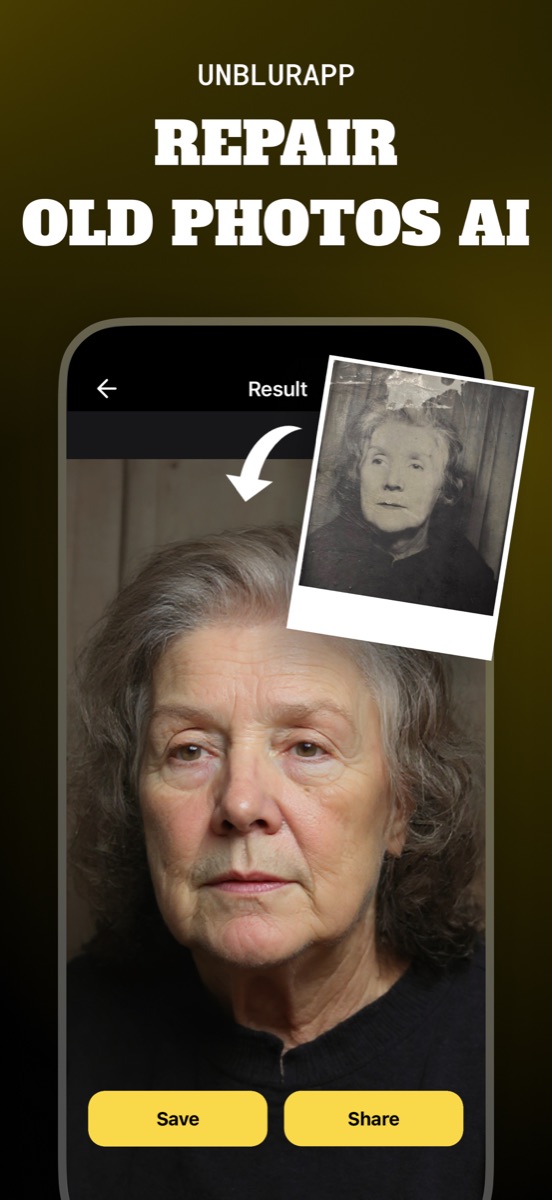
For fading, softness, dust, light scratches, low resolution and missing colour, the gap between an app and a professional has narrowed to the point where the difference is often invisible at print size. These cases make up the large majority of a typical family box.
The app also wins on a factor services cannot touch: volume. Two hundred prints at even $25 each is a five-thousand-dollar project. The same box on a phone is an afternoon.
Where a professional is worth the money
Four situations justify the cost, and it is a short list.
A print that is physically stuck to glass or to another print, where the problem is conservation rather than image processing. A photograph with genuine historical or monetary value, which should be handled by someone insured to handle it. A severely damaged face on the one photograph the family cares most about. And anything where the restoration will be presented as a record, such as archive or genealogical work, since a human can document what was reconstructed and what was recovered.
A sensible order of operations
Run the box through an app first. It costs almost nothing and it tells you what you are dealing with: most photos will come back good enough to print and share, which shrinks the list of candidates for professional work to a handful.
Then take that handful to a service, with the digital captures already made. Studios generally prefer a good scan over a shipped original anyway, and you avoid posting irreplaceable prints across the country.
Questions to ask a studio
Ask what resolution they deliver and in what format, since a restoration returned at screen size cannot be printed. Ask whether they return the untouched scan alongside the restored file, which any serious operation does. Ask what they do about faces where information is missing, and listen for whether the answer involves asking you for reference photos.
A studio that wants reference pictures of your grandmother is doing the work properly. One that promises a perfect result from a destroyed face without asking anything is describing the same guesswork an app does, at two hundred times the price.
Questions people also ask
How much does professional photo restoration cost?
Roughly $25 to $75 for light work and several hundred for severe damage, depending on the studio and the hours involved. Turnaround is usually several days to a couple of weeks.
Is AI restoration as good as a professional?
For fading, softness, light damage and resolution, often yes. For a badly damaged face, a human working from other photographs of the same person still produces a more faithful result.
Related guides

How to restore old damaged photos
Repair damaged photos with cracks, scratches, tape marks and torn corners. How to handle a fragile print, capture it safely, and rebuild it with AI.
Read the guide →
How AI photo restoration works
How AI photo restoration rebuilds faded, blurry and damaged pictures, why the results are plausible rather than recovered, and when to trust them.
Read the guide →
Free online photo restoration, honestly assessed
Old photo restoration online free: how the free tiers work, where the catch usually is, and how to get a full-resolution result without paying for a bad one.
Read the guide →